Asbestos Exposure: What It Is, Where It Happens, and Why It Matters Legally

Updated November 10, 2026

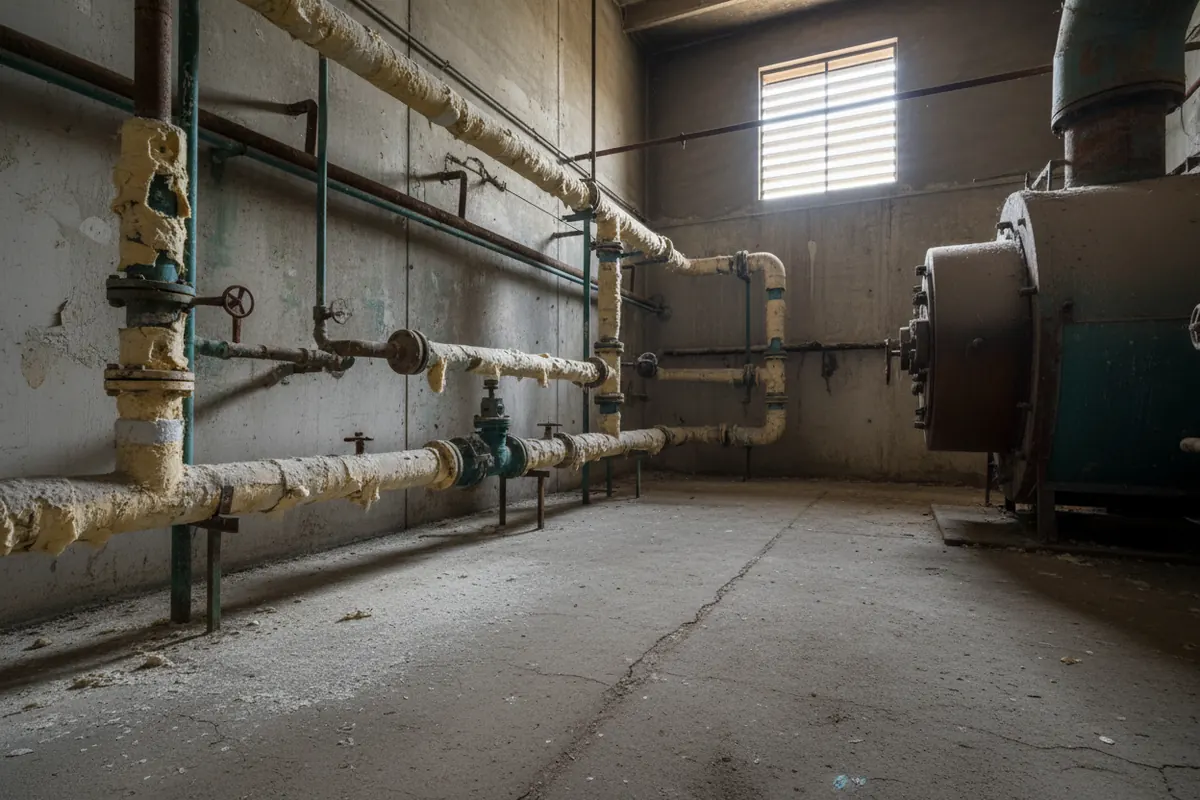
Crumbling pipe insulation in an abandoned boiler room where fibrous dust settled on concrete floors.
Immediate answer

Asbestos exposure means breathing fibers released when old materials are disturbed. Where it happens, the diseases tied to it, and how it connects to a claim.

On this page
  1. What Asbestos Exposure Means for Someone Facing a Diagnosis
  2. Where Asbestos Fibers Are Released, and Where Your Exposure May Have Happened
  3. The Diseases Linked to Asbestos Exposure
  4. Why the Gap Between Exposure and Diagnosis Shapes a Legal Claim
  5. What a Legal Claim Has to Show After an Asbestos Diagnosis
  6. Evidence That Tends to Matter in Asbestos Cases
  7. Frequently asked questions
  8. Sources

Asbestos exposure means breathing in or swallowing tiny mineral fibers that are released when asbestos-containing material is cut, drilled, torn out or allowed to break down. Most people meet low levels without becoming ill. Disease usually follows regular or heavy contact, often at work, and it can appear decades later. That long gap is why exposure history matters legally.

Most people facing this question have just heard a word like mesothelioma or asbestosis from a doctor, either about themselves or about a parent or spouse. They are trying to work out how something from a job, a ship or a house thirty or forty years ago could be behind an illness today. They also want to know whether that history has anything to do with the law. This page walks through what exposure is, where it happens, the diseases federal health agencies link to it, and how an exposure decades ago connects to a claim brought now.

What Asbestos Exposure Means for Someone Facing a Diagnosis

If a doctor has raised asbestos, it helps to know what the material is. The U.S. Environmental Protection Agency describes asbestos as a mineral fiber that occurs naturally in rock and soil. The Agency for Toxic Substances and Disease Registry (ATSDR) calls it "a commercial and legal term referring to a class of minerals that naturally form long, thin, very strong fibers." Each fiber is too small to see. The fibers resist heat and fire, do not dissolve in water or evaporate, and cannot be broken down easily by chemicals or bacteria. Those qualities made asbestos useful in building materials and industrial products, and they are part of why it stays in the body.

Old records and product labels may name a specific type of asbestos, and ATSDR's grouping helps make sense of them. It says the legal definition covers six fibrous minerals in two classes: chrysotile, also called white asbestos, in the serpentine class, and amosite, crocidolite, anthophyllite, tremolite and actinolite in the amphibole class. ATSDR states that exposure to either class increases the risk of disease, and that amphiboles stay in the lung longer.

Exposure, in plain terms, means taking in fibers that have been released into the air. The National Cancer Institute's asbestos fact sheet states: "Everyone is exposed to asbestos at some time during their life." Low levels are present in air, water and soil. "However, most people do not become ill from their exposure." The people who do become ill, NCI says, "are usually those who are exposed to it on a regular basis, most often in a job where they work directly with the material or through substantial environmental contact."

If you are trying to connect an illness to the past, that distinction carries weight. The question medically and legally is rarely whether a person ever encountered asbestos. It is where, how often and how heavily, and those details are what an attorney conversation usually starts with.

Where Asbestos Fibers Are Released, and Where Your Exposure May Have Happened

Disturbance is the trigger. The EPA states that fibers "may be released into the air by the disturbance of asbestos-containing material during product use, demolition work, building or home maintenance, repair, and remodeling," and that "in general, exposure may occur only when the asbestos-containing material is disturbed or damaged in some way." Intact material left alone is, under that general rule, not what releases fibers.

For a family looking back, this means the moments worth recalling are the ones when material was worked on: a renovation, a repair job, a tear-out. Exposure tends to fall into three broad settings.

At work. The Occupational Safety and Health Administration states that heavy exposures "tend to occur in the construction industry and in ship repair, particularly during the removal of asbestos materials due to renovation, repairs, or demolition." OSHA adds that workers are likely to be exposed during the manufacture of asbestos products, such as textiles, friction products, insulation and other building materials, and during automotive brake and clutch repair. NCI's fact sheet lists shipbuilding trades, asbestos mining and milling, insulation work in construction, and demolition workers, drywall removers, asbestos removal workers, firefighters and automobile workers. Occupational asbestos exposure is covered on its own page.

At home and in older buildings. ATSDR notes that asbestos "is still present in older homes and buildings." The EPA's list of places it may be found includes vermiculite attic and wall insulation, vinyl floor tiles and sheet-flooring backing and adhesives, roofing and siding shingles, textured paint and patching compounds, pipes covered with asbestos material or tape, and oil and coal furnaces with asbestos insulation and door gaskets. NCI also describes family members of heavily exposed workers facing increased mesothelioma risk from fibers carried home on shoes, clothing, skin and hair, the subject of secondary asbestos exposure.

In the community. ATSDR states asbestos occurs in the environment "both naturally and from the breakdown or disposal of old asbestos products," and can be found near the ground surface in certain areas. NCI reports mesothelioma in people without occupational exposure who live close to asbestos mines.

Each setting points to different possible sources, and the setting often shapes which legal theory, if any, may apply.

The Diseases Linked to Asbestos Exposure

According to NCI, asbestos is classified as a known human carcinogen by the U.S. Department of Health and Human Services, the EPA and the International Agency for Research on Cancer. NCI reports IARC's conclusion that there is sufficient evidence that asbestos causes mesothelioma and cancers of the lung, larynx and ovary, and states that "it is thought that most mesotheliomas are due to asbestos exposure."

Mesothelioma is described by NCI as "a relatively rare cancer of the thin membranes that line the chest and abdomen." The EPA describes it as a rare cancer found in the thin lining of the lung, chest, abdomen and heart.

Asbestosis is a buildup of "scar-like tissue in the lungs," in OSHA's words, which can "result in loss of lung function that often progresses to disability and death." The EPA calls it "a serious progressive, long-term, non-cancer disease of the lungs."

The long delay is the part families find hardest to grasp. NCI states that people who develop asbestos-related diseases "show no signs of illness for a long time after exposure," and that "it can take from 10 to 40 years or more for symptoms of an asbestos-related condition to appear." The EPA says symptoms "may take many years to develop."

On how much exposure matters, NCI states that health risks "increase with heavier exposure and longer exposure time," yet "investigators have found asbestos-related diseases in individuals with only brief exposures." OSHA states, "There is no 'safe' level of asbestos exposure for any type of asbestos fiber," and that exposures "as short in duration as a few days have caused mesothelioma in humans."

This background is context for legal questions, not medical guidance. Whether a particular illness is asbestos-related is a medical determination, and disease claims rest on medical review. The EPA notes that doctors usually identify possible exposure by taking a thorough history of a person's medical, work, cultural and environmental background.

If you were diagnosed this year, the exposure that matters may have happened before you married, before your children were born, at a job you left long ago. That separation, measured in decades, is the core practical problem in these cases.

A statute of limitations is a law that sets the period within which a lawsuit has to be filed. Because the disease can appear so long after exposure, the questions that tend to matter are how long the period is and what event starts it running. Each state answers those questions under its own law, and the length, the starting point and the exceptions differ from state to state. Fault rules, which decide how responsibility is shared among more than one party, and damages rules also vary by state. Which state's law applies can itself depend on where a person lived, worked or was exposed.

The latency gap also shapes the search for a source. A person may have held several jobs, served in the military, and renovated a home, each a possible exposure setting. Reconstructing that history is how families piece together where and when exposure happened. The records that usually come up include employment and union records, military service records, medical records, and anything that identifies the products used at a job or on a ship.

Veterans and their families meet a further distinction. Service branch, the era of service and the kind of duty, such as shipboard or construction work, shape the historical exposure picture. VA benefits and civil claims are separate processes with different standards, and not every veteran qualifies for either; eligibility turns on service history, diagnosis and other factors. Questions on that path are covered under military service and asbestos.

Trust fund claims and civil lawsuits are also distinct mechanisms. They follow different rules, and the existence of one does not mean the other is open in a given situation.

When the questions turn to which state's limitation period applies and which records bear on a particular history, a conversation with our attorney can go through the dates, the places and the diagnosis involved. That conversation can begin with a request for a case evaluation.

A diagnosis alone does not establish a legal claim. The law asks for specific elements, and whether they are met depends on the facts of each case and the law of the state that governs it. For a family, this means the useful question is less "is this illness serious" than "who was responsible for the material, and can that be shown."

Many asbestos claims are framed in negligence, the failure to use reasonable care. A negligence claim generally asks four things. Duty means the party had a legal obligation to act with reasonable care toward the person. Breach means it fell short of that care. Causation means that failure actually led to the injury. Damages means a real harm resulted.

If the exposure traces to a particular product, such as insulation, brakes or floor tile, product liability may be the framework that fits. It asks whether the product had a defect, meaning a flaw in its design, manufacture or warnings, and whether that defect caused the injury. Premises liability addresses the duty a property owner may owe people on the property regarding hazardous conditions there. Which framework fits depends on who made, sold, installed or controlled the material.

Causation is often the most contested question. It means connecting a particular exposure, from a particular source, to the disease that was diagnosed. With decades between the two and several possible exposure settings, that link is where many disputes center, and it is much of what an attorney review works through. More on how these cases are put together appears under asbestos lawyer.

When a person dies from an asbestos-related disease, state law may allow a wrongful death claim, which is a claim brought by certain family members or the estate for losses caused by the death. Who may bring it, what it covers and its deadline differ from state to state.

Damages, the losses the law may allow a person to recover, fall into categories such as medical expenses, lost income, and pain and suffering, along with wrongful-death damages after a death. Which categories are available, and how they are measured, depend on the state's law and the facts. None of this means a particular person has a claim; it describes what the law asks.

Evidence That Tends to Matter in Asbestos Cases

Evidence in these cases is mostly about answering two questions: where the person was exposed, and to what. If you are a spouse or adult child reconstructing a parent's working life, you may already hold more of this than you realize, in old pay stubs, discharge papers or a box of union cards.

Employment and union records place a person at a workplace and describe the role they held. Military service records can document shipboard duty, construction work or other service settings where asbestos was present. Medical records and pathology reports establish the diagnosis and the type of disease. NCI notes that a lung biopsy is the most reliable test to confirm exposure, while cautioning that such procedures "cannot determine how much asbestos an individual may have been exposed to or whether disease will develop."

Product identification connects a specific asbestos-containing product to the exposure setting. This is often where causation is built or lost, because the question is not only whether asbestos was present but whose product it was. Witness accounts from coworkers, shipmates or others who remember the conditions at a worksite can fill gaps that paperwork leaves open.

Time works against every category. Companies may have dissolved or merged, records may be incomplete, and documents may now sit with a successor business. Coworkers may be hard to locate. Those gaps do not end the inquiry, but they shape how an exposure history is pieced together.

Free case evaluation

No Fee Unless We Win Your Case

A free case evaluation is how it starts. Tell us what happened, and we’ll help you understand your options. You pay no fee unless we win your case.

Mesothelioma Legal Advocates

How it works

  1. Call us or request a free case evaluationTell us what happened, in your own words.
  2. Talk through your caseYour options, and what your case may be worth.
  3. No fee unless we winYou pay no attorney fee unless we win your case.
Free case evaluation

Tell Us What Happened

Frequently asked questions

What are the last stages of asbestosis?

OSHA describes asbestosis as scar-like tissue in the lungs that can cause loss of lung function that "often progresses to disability and death." The EPA calls it a serious, progressive, long-term disease. How it progresses for any one person is a medical question for that person's doctors; this page offers legal context only.

How long after asbestos exposure do symptoms appear?

NCI states that it can take from 10 to 40 years or more for symptoms of an asbestos-related condition to appear, and that people often show no signs of illness for a long time after exposure. The EPA likewise says symptoms may take many years to develop.

Will a brief or one-time asbestos exposure cause illness?

NCI says most people exposed to asbestos do not become ill, and those who do are usually exposed regularly. NCI also notes disease has been found after only brief exposures, and OSHA states there is no safe level and that exposures of a few days have caused mesothelioma. Risk rises with heavier and longer exposure.

Is there a test for asbestos exposure?

NCI calls a lung biopsy the most reliable test to confirm exposure and describes bronchoscopy as a less invasive option, while noting neither shows how much exposure occurred or whether disease will develop. The EPA lists physical examination, chest x-ray and pulmonary function tests among diagnostic tools. Which tests fit is a doctor's decision.

What should someone know if they think they were exposed to asbestos at home?

The EPA says older homes may contain asbestos in insulation, floor tiles, shingles, textured paint and pipe coverings, and that exposure generally occurs only when such material is disturbed or damaged, as in remodeling or repair. A legal question about home exposure usually involves the premises liability or product liability principles described above.

What is the difference between a trust fund claim and a lawsuit for asbestos exposure?

They are distinct mechanisms. A civil lawsuit is filed in court and decided under state law, while a trust fund claim is submitted to a trust under that trust's own rules. Eligibility differs, and one being open does not mean the other is. The trust process is explained under asbestos trust fund claims on this site.

Do veterans have different options for asbestos-related claims?

VA benefits and civil claims are separate processes with different standards. Service branch, era and type of duty shape the exposure history, but not every veteran qualifies for either path; eligibility depends on service history, the diagnosis and other factors.

How does a statute of limitations work in an asbestos case?

It is the filing period for a lawsuit, and each state sets its own version. Because asbestos disease appears so long after exposure, the starting point often matters as much as the length, as discussed in the section on the gap between exposure and diagnosis above.